
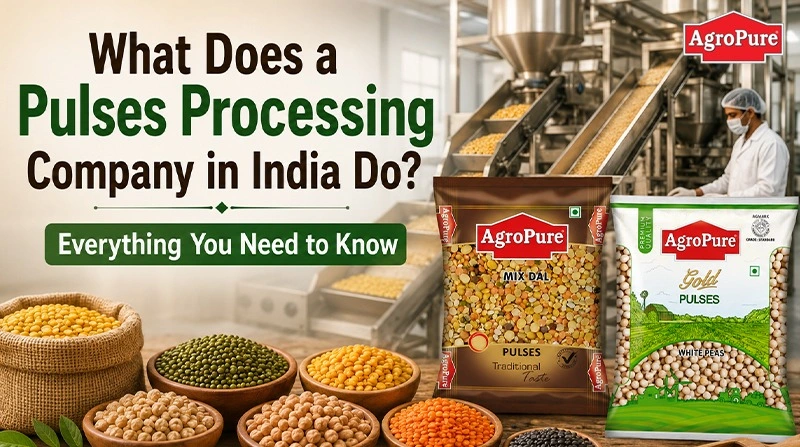
For B2B buyers, it is not only about getting the lowest quotation when sourcing pulses or besan from a supplier. Long term sourcing relationships can be influenced by product consistency, processing capabilities, food safety, packaging, supply capacity and export readiness.
There are many pulses manufacturers in India and buyers need a systematic way to evaluate possible suppliers before they place regular or bulk orders. Here’s a practical checklist to help.
1. Check Out The Product Line-Up
Check first if the manufacturer can supply the products your business really needs. A supplier with a broad portfolio may be useful for distributors, retailers, food-service companies and international buyers sourcing multiple products.
AgroPure’s pulses portfolio includes Moong, Masoor, Chana, Urad, Rajma, Kabuli Chana, Lobia, White Peas, Mix Dal, Dal Makhani and other varieties. The products are available in various forms like whole, split and dehulled pulses.
For besan buyers, it is equally important to know the application for the product and packaging formats available before placing bulk orders.
2. Verify In-house Processing Ability
Processing is one of the most important things to look at while you’re looking at a besan manufacturer or pulse supplier. Ask where the processing takes place, what technology is used and how they monitor quality and hygiene throughout the process.
AgroPure says its in-house processing employs the latest processing technology with a strong focus on hygiene and uniformity. The company says it has a processing capacity of more than 1,500 metric tonnes per day.
It also allows for more control over production and can help manufacturers maintain consistency between orders.
3. Examine Food Safety and Certifications
A reliable B2B supplier should be able to demonstrate appropriate food safety systems and certifications. The exact requirements will depend on the product, destination market and application.
AgroPure lists HALAL, HACCP, FSSAI, AGMARK, BRCGS, ISO 22000 and FSSC 22000 among its certifications and compliance credentials.
Before ordering, buyers should verify which certifications apply to the specific product and shipment they are purchasing.
4. Assess Capacity and Supply Reliability
A supplier may offer the right product but still be unsuitable if it cannot consistently fulfil your required volumes.
B2B buyers should ask about:
AgroPure reports more than 1,500 metric tonnes of daily processing capacity and more than 55 years of experience in the industry.
These details can be useful when assessing whether a supplier can support recurring procurement rather than only individual orders.
5. Evaluate Packaging and Product Handling
Packaging is especially important for pulses and besan because products may pass through several stages of transportation, storage and distribution before reaching the end customer.
Ask potential suppliers about available pack sizes, packaging materials, labelling requirements, shelf life and storage recommendations.
AgroPure states that its products are packed under quality checks intended to preserve freshness, nutrition and shelf life. Its product portfolio also includes both household and larger pack formats, depending on the product.
6. Consider Export Experience
Experience with international supply chains is another factor to check out if you are importing Indian food products. Buyers should ensure that the supplier understands the documentation, packaging and quality requirements for their destination as pulses exporters in India may be serving different markets.
AgroPure says it supplies Indian staples to more than 25 countries and to contact for export enquiries and bulk orders.
7. Request Samples Before a Large Order
Before finalising a supplier, request samples and assess the product against your requirements. Depending on your business this can include appearance, consistency, packaging, cooking performance and other relevant specifications;
A sample evaluation may be useful in identifying differences between suppliers before entering into a larger procurement arrangement.
Before choosing a manufacturer, confirm:
For businesses comparing pulses manufacturers in India, these checks provide a more meaningful basis for supplier evaluation than price alone.
1. What should I check before choosing a besan manufacturer?
Review the manufacturer’s processing practices, quality controls, certifications, product specifications, packaging options, capacity and ability to meet your required volumes.
2. Why is in-house processing important for B2B buyers?
In-house processing can give a manufacturer greater control over production, processing standards and product consistency. AgroPure states that its products are processed in-house.
3. What should I look for in pulses exporters in India?
Check their product range, processing capabilities, certifications, packaging, export experience, documentation and ability to maintain consistent supply.
4. Where is AgroPure located?
AgroPure lists its facility at F-1734-1735, DSIIDC Industrial Area, Narela, Delhi, India.
5. Does AgroPure supply both pulses and besan?
AgroPure’s website presents pulses as a major product category and also features AgroPure Premium Besan in its food content and product-related material.
Delivering purity, nutrition and trust
to millions of families and markets
around the world.
© 2026 GPA Capital Foods Private Limited. All Rights Reserved.
Quick Links
Contact Us